








"The CGT industry globally is currently facing capital cooling, homogeneous competition, and commercialization pressures, but at the same time, structural opportunities are emerging. Although Chinese companies still need to improve their originality and global capabilities, they have also demonstrated flexible adaptability and local advantages—especially in areas such as IIT research and manufacturing process optimization, where they possess unique development conditions."
"The key to breakthroughs in the CGT industry lies in whether companies can launch products with true clinical value and international competitiveness, and rebuild market confidence through solid data and mature processes. Against the backdrop of deepening global industrial division of labor, Chinese CGT companies are gradually transitioning from followers to innovators, and are expected to play a more significant role on the international stage in the future."
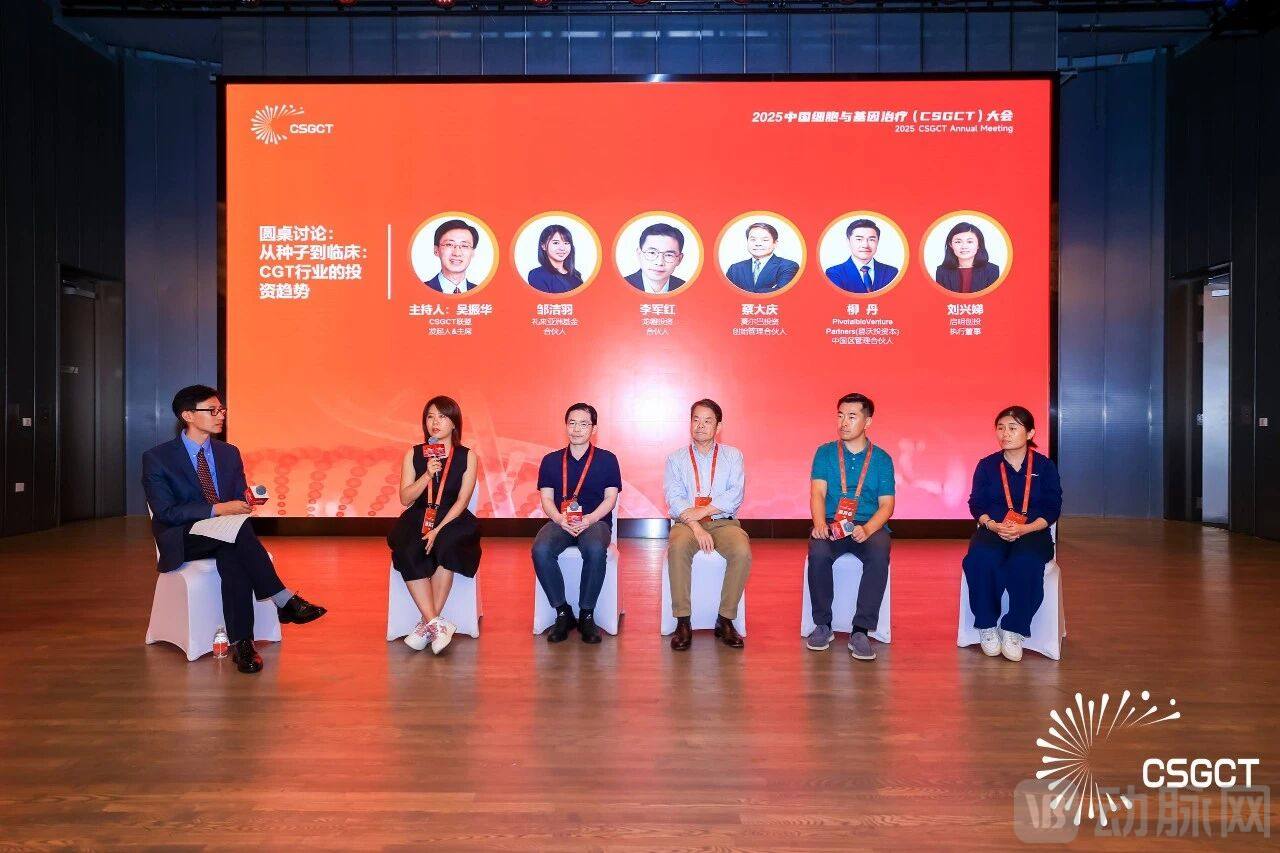
Recently, during the roundtable dialogue of the "CGT Investment and Financing Trends and BD Cooperation Opportunities" sub‑forum at the 2nd China Cell and Gene Therapy Conference (CSGCT), Zou Jieyu, Partner at Lilly Asia Ventures; Li Junhong, Partner at Dragonpine Capital; Cai Daqing, Founding Managing Partner of Sherpa Healthcare Partners; Liu Dan, China Managing Partner of Pivotalbio Venture Partners; and Liu Xingdi, Executive Director of Qiming Venture Partners, engaged in an in‑depth discussion on the theme "From Seed to Clinic: Investment Trends in the CGT Industry."
The 2nd CSGCT was held under the guidance of the Haidian District People's Government of Beijing, co‑hosted by the Zhongguancun Science City Management Committee and the CSGCT China Cell and Gene Therapy Alliance, and organized by the HIEA Medical Innovation Ecosystem Alliance and Arterial Network (VBDATA).
Guided by the core philosophy of "Rooted in Regulation, Harnessing Wisdom, Connecting Globally, and Creating a Shared Future" and themed "Global Market, China's Power," the conference featured one main forum, 15 sub‑forums, and two project roadshows, attracting nearly 2,000 participants, including scientists, clinicians, entrepreneurs, and investors, among whom were more than 10 internationally renowned CGT leaders, to discuss the development strategies for cell and gene therapy.
Zou Jieyu, Partner at Lilly Asia Ventures:
CGT companies need a global market perspective
In recent years, the CGT industry and even the entire biotech sector have faced significant pressure, especially for companies with insufficient pipeline differentiation, unclear product progress, or uncertain commercialization prospects. In such an environment, CGT companies must adopt a global market perspective.
For the CGT field, relying solely on the Chinese market has clear limitations. If a product lacks global competitiveness, it will face multiple practical challenges, including pricing and commercial distribution. Taking CAR‑T as an example, domestic commercialization and clinical trials have already captured a considerable share of patient resources for mainstream targets such as CD19 and BCMA. Coupled with competition from hospital‑prepared formulations, CGT companies focused only on the Chinese market will find it difficult to sustain development.
However, going global is not simple. CGT projects are more complex and expensive in terms of global clinical trials and CMC (chemistry, manufacturing, and controls). Moreover, CGT companies need global operational capabilities—many companies thought they only had to deal with the "Chinese exam paper," only to later realize they need to master "ten languages."
At the same time, it is worth noting that some CGT companies have already demonstrated rapid adaptability. Beyond going global, some small nucleic acid companies and those transitioning to in vivo CAR‑T have found development opportunities amid challenges by flexibly adjusting their strategies.
Li Junhong, Partner at Dragonpine Capital:
Chinese CGT companies have strong adaptability
Much of China's innovation in biomedicine still follows global trends, particularly those of the United States, and needs improvement in originality and differentiation. Due to high homogeneity in innovation, when overseas markets experience risks such as commercialization shortfalls, delivery issues, or safety concerns in a particular sub‑segment, the corresponding domestic segment is often affected and shows similar fluctuations. At the same time, China's payment system differs significantly from overseas markets like the U.S., and this structural factor amplifies the impact of industry cycles on domestic companies.
However, Chinese companies have demonstrated strong adaptability in responding to global changes. They flexibly address challenges through measures such as patent transfers, production base relocations, and R&D site adjustments. This has been seen in industries like new energy, and there is confidence that CGT companies will ultimately find different paths to adapt flexibly and benefit from innovation.
The current state of the biopharmaceutical industry also aligns with the global trend of pharmaceutical division of labor. After more than twenty years of development, China has built a solid foundation in engineering talent and technical infrastructure. It is gradually undertaking more fundamental work in the global R&D chain and moving toward more original innovation. This is an inevitable result of global industrial division and a major opportunity for China's biopharmaceutical industry. In time, China's pharmaceutical R&D will surely reach a higher stage centered on innovation.
Cai Daqing, Founding Managing Partner of Sherpa Healthcare Partners:
The CGT industry needs truly high‑quality products to boost confidence
The key to whether the CGT industry can break out of its downturn is whether truly high‑quality products can emerge. Whether in global or domestic markets, there must be "outstanding" products to restore industry confidence. Although the industry is currently in a trough, a group of practitioners and investors remain committed, and this persistence deserves respect.
The CGT industry currently faces multiple challenges: five to seven years ago, investors enthusiastically pursued innovative therapeutic models, but investment enthusiasm has cooled in recent years—though there is belief that the industry will recover within three to five years. The public, doctors, and even some investors sometimes have doubts about the industry. While biologics are good, the market can also experience "fatigue." Additionally, there is uncertainty in international markets.
The key to overcoming these challenges is for CGT companies to deliver products with significant efficacy, solid data, and true value, and to prove their commercial potential. Trust must be rebuilt through increasingly better products, more mature CMC processes, and eventually approved drugs.
Liu Dan, China Managing Partner of Pivotalbio Venture Partners:
China's CGT is in a phase of "breaking before establishing
From a technological development perspective, CGT has evolved from initial gene replacement therapy to various modalities including small nucleic acids and cell therapy, gradually moving from the cell surface to intracellular targets and different cell types, forming a unique technological system. CGT is highly complementary to traditional treatment methods. Although there are multiple potential treatment options for some indications, CGT remains one of the important future trends.
The development of China's CGT industry has largely followed foreign experience, but foreign enthusiasm for this field is not as high as expected in China, with few successful commercialization cases. Based on years of investment experience in China and exchanges with foreign ecosystems, I believe that China will forge its own path in CGT, forming a unique industrial logic that may even influence the ecosystems of the U.S. and other international markets. This confidence stems from China's accumulated data and product achievements—a scientifically rigorous ecosystem will ultimately earn recognition through genuine results.
China's CGT is currently in a phase of "breaking before establishing," needing to prove its strength to guide international markets in reverse. However, it is also important to note that although CGT has significant potential in certain disease areas (such as oncology and autoimmune diseases), market size and patient affordability for many diseases remain limited in China. Therefore, ultimately, going global is necessary to build competitiveness.
Liu Xingdi, Executive Director of Qiming Venture Partners:
Stay rational during downturns; no need to panic
Regarding industry cycles, the biotech sector has historically seen alternating booms and busts. For example, after a downturn, small nucleic acid technology experienced a new wave of development thanks to Alnylam's commercial success.
Therefore, the advice for Chinese CGT companies is as follows: stay rational during downturns without excessive panic; return to the essence of the technology, clarify your technical differentiators, and develop clinically valuable products based on them; make good use of local resource advantages, especially China's favorable IIT environment, which is somewhat unique internationally; validate product value through clinical trials and choose areas with high medical needs to generate compelling clinical data—high‑quality data will naturally attract big pharma attention and even acquisitions; the key to breaking through homogeneous competition remains technical differentiation and superiority.
For capital, successful exit depends on multiple factors including timing, market conditions, and founder willingness—such as secondary market cycles and the founder's intentions. If a founder aims to build a long‑term sustainable company, secondary market fluctuations will eventually present exit windows. If a founder prefers a shorter‑term exit, options like BD or M&A should be explored.
However, the prerequisite for any successful exit is that the company's products are excellent enough to achieve a commercial closed loop. Biotech companies ultimately need to be profitable, no different from other industries. Until breakeven, companies remain at risk, so they must be psychologically prepared for capital market volatility.


















 渝公网安备 50011202502165号